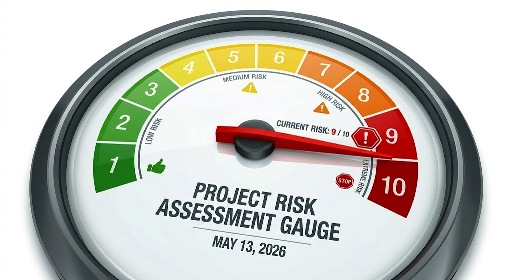
Based on the analysis of the project documentation, moving to an IP-based infrastructure completely shifts the facility's risk profile. In legacy systems, physical routing topology determined system stability. In an ST 2110 environment, the primary failure mode migrates from physical component drops to software orchestration and control plane coordination failures.
Core Risk Identification & Analysis
1. Control Plane & NMOS Registry Vulnerabilities
- Risk Description: Heavy reliance on open control standards (IS-04 for discovery and IS-05 for connection management) creates a highly dynamic environment. If the central NMOS registry fails, drops state, or contains stale data, multi-vendor devices cannot discover or connect to one another.
- Impact: Complete loss of operational agility; the network switch fabric might pass packets perfectly while the endpoints remain entirely blind to stream changes.
2. Control Authority Ambiguity (Split-Brain Scenarios)
- Risk Description: In an environment bridging multiple vendor ecosystems, control ownership can become highly contested. Without rigid boundaries, multiple software controllers or broadcast orchestrators can issue conflicting commands to a single endpoint.
- Impact: Unpredictable device behavior, stream hijacking, or lockouts during live production environments.
3. Data-Plane Isolation & Redundancy Failures
- Risk Description: Assuming that a dual-network fabric (A/B paths) automatically guarantees hitless failover without contractually validating the software's deterministic decision-making logic.
- Impact: Automated failover mechanisms might fail to execute during a network partition, turning a minor switch hiccup into a systemic, manual recovery headache.
4. Telemetry and Packet-Level Visibility Gaps
- Risk Description: Relying on legacy monitoring paradigms—where basic signal presence or link-light activity was sufficient to determine system health. ST 2110 requires real-time telemetry tracking, IGMP multicast join validation, clock accuracy (PTP), and strict packet pacing.
- Impact: Total operational blindness when intermittent packet drops or timing thresholds degrade video quality, leading to a loss of operator confidence.
5. Brittle API and Software Dependencies
- Risk Description: Modern control layers depend heavily on distributed REST APIs, JSON messaging, database lookups, and third-party software development kits (SDKs). Unmapped version mismatches or unhandled authentication timeout rules introduce cascading failure risks.
- Impact: Routine software updates from a single vendor can break critical control integration hooks across the entire broadcast ecosystem.
Paradigm Shift: Legacy vs. ST 2110
| Risk Vector | Legacy SDI Environment | Modern ST 2110 Environment |
|---|---|---|
| Primary Failure Point | Deterministic physical hardware / BNC connections | Logical orchestration / Software control planes |
| System Behavior Target | Physical wiring layouts and hardware matrix size | Software state management and multi-vendor APIs |
| System Health Baseline | Signal presence / Simple continuity | Telemetry metrics / Packet pacing / PTP timing |
Mitigation Recommendation
The Software Functionality Document can no longer be treated as a basic user-interface guide. To minimize implementation risk, it must be upgraded to a foundational systems-integration governance contract that explicitly dictates vendor API requirements, failover logic, registry behavior, and operational failure states before hardware deployment begins.
UPDATED
5/18/26
V260518-1.0